
MR D. TAIL'S BLOG

A little creature who is discovering the technical and poetry side of architecture... and more.
#044 - ENERGY EFFICIENCY RATING
The energy efficiency rating is a measure of the overall efficiency of a home. The higher the rating the more energy efficient the home is and the lower the fuel bills will be. This score is found on an Energy Performance Certificates (EPCs), a mandatory document, in England and Wells, which states the energy efficiency of the building when rent or sold.
This is a result of European Union Directive 2002/91/EC relating to the energy performance of buildings. The principle of this directive is to make energy use in buildings transparent by the issuing of a certificate showing the energy rating of a property, along with recommendations on how to improve efficiency.
As Mr D. Tail demonstrates, a Passive house has a high rating because it has an excellent level of insulation and airtightness.
On the contrary an old Victorian house, non-insulated with uncontrolled draughts that let air come in and out, show a low rating.
However we should not lose hope if we own an old house. Today the construction market offer plenty of products that help us to improve the building performance of a house to an acceptable level, even a Victorian house.
#022 - LONDON SKYLINE

Recently there have been a lot of discussion, concern and complains around the London Skyline. AJ magazine launched its Skyline campaign earlier this year together with the Observer newspaper. Their main objective is to persuade the Mayor of London to do something in stopping the poorly-designed tower blocks ruining the capital’s skyline.
Here Mr D. Tail is making his point about this intricate matter.
More info below:
www.architectsjournal.co.uk/LONDONSKYLINE
#018 - INCLINED SURFACES

An inclined surface provides access between two different levels. It is named differently depending on how steep is its surface.
Building regulations (more or less) state:
- It is assumed that an inclined surface with gradient of 1:60 (or 1deg) or less steep is level (or rather flat);
- It is assumed that an inclined surface with gradient steeper than 1:60 (or 1deg) but less steeper than 1:20 (or 1.6deg) is gently sloping;
- It is assumed that an inclined surface with gradient steeper than 1:20 (or 1.6deg) but less steeper than 1:12 (or 2.8deg) is a ramp;
- It is assumed that an inclined surface with gradient steeper of 1:12 (or 2.8deg) is too steep (or rather steep ramp) and should be avoided. In these cases stairs are desirable.
#017 - EGRESS WINDOWS
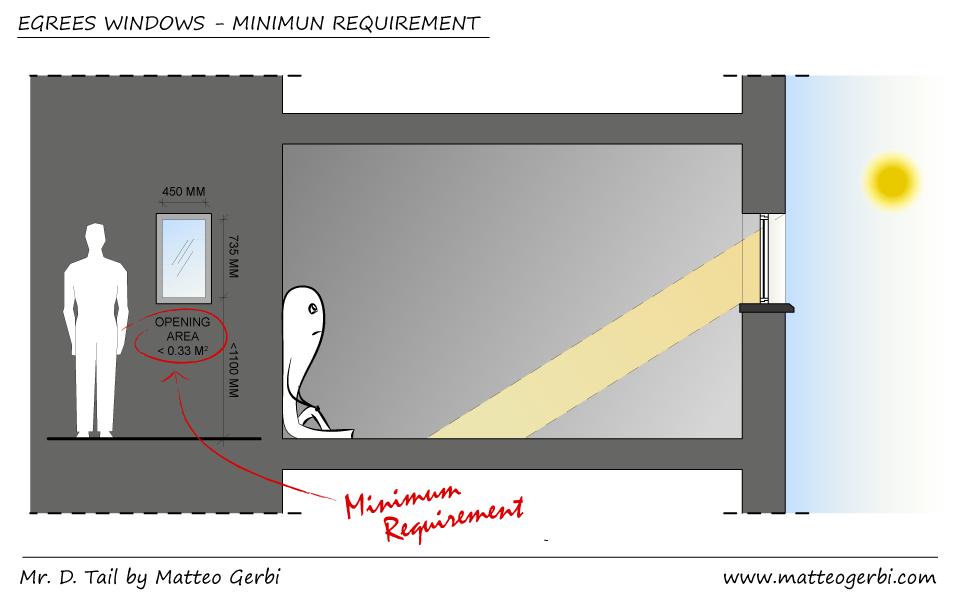
The Building Regulations (B1 – 2.8/A ) states that any window which is provided for emergency egress should have an unobstructed clear opening area that is at least 0.33m2 and must have a minimum dimension of 450mm high and 450mm wide. The same size of an average cushion.
Is it small windows? Yes it is. At least the London Housing Design Guide requires all habitable rooms to have a window area equivalent to at least 20% of the floor area, which is a sensible approach to the design. This should be a national rule as there are many individuals happy to speculate on it.
#010 - SPACE IS TODAY’S LUXURY

According to the London Housing Design Guide the minimum standard space for one bed room flat for two people is 50 square meters; outside London unfortunately you can easily find much smaller spaces.
Mr D. Tail is living in one of this tiny apartment, and he is demonstrating how minute the apartment can be once you start to unpack stuff. There's nowhere to store things and the apartment has soon become a hurdling track.
Space is today’s luxury.
#003 - MINIMUM CEILING HEIGHT
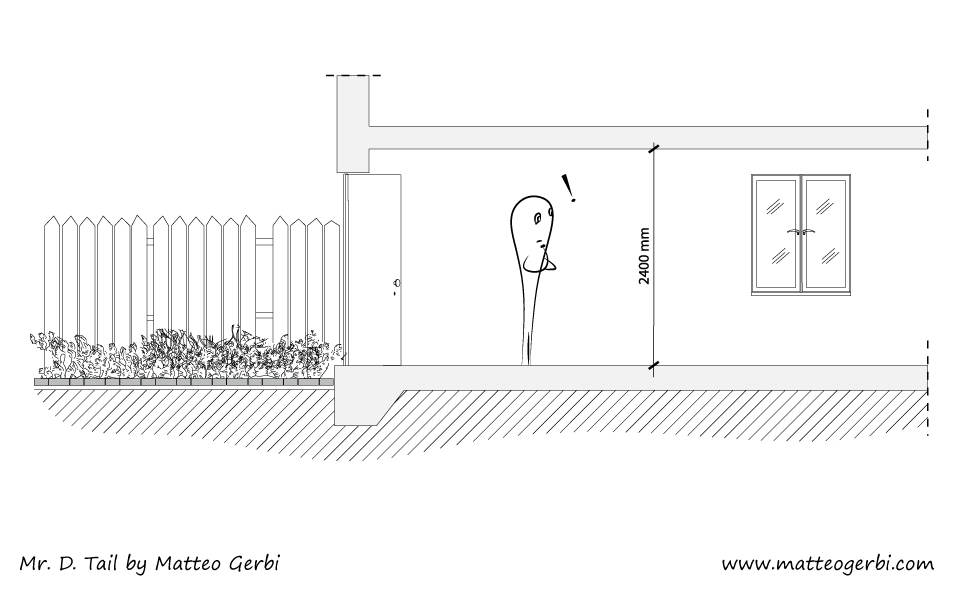
However UK building regulations currently do not specified minimum ceiling height. If your ceiling is 2.4m high consider yourself a lucky person.
DISCLAIMER: Mr D. Tail and his authors accept no responsibility or liability for any damages or costs of any type arising out of or in any way connected with your use of the data and information content in this web site. Data and information is provided for information purposes only, (and for having some fun) and is not intended for trading/training purposes. Mr D. Tail and his authors shall be liable for any errors in the content, or for any actions taken in reliance thereon.